Why kpnn2
This page explains why kpnn2 exists: the kind of model it is for,
what goes wrong when you build that model in plain PyTorch, and
what the package checks for you. To build a first model instead,
start with the quick start.
Deep neural networks are accurate predictors but opaque ones. Their hidden units carry no names: a unit deep inside a trained network has no meaning outside the model, so attribution methods, which score how much each input or unit contributes to a prediction, can say which units matter but not what they are. For scientific use this is a serious limitation, because a prediction can be checked against data, but only a mechanism can be tested by experiment. One line of work in interpretable machine learning therefore builds meaning into the architecture itself, so that the internal units of a network correspond to entities a scientist already knows by name.
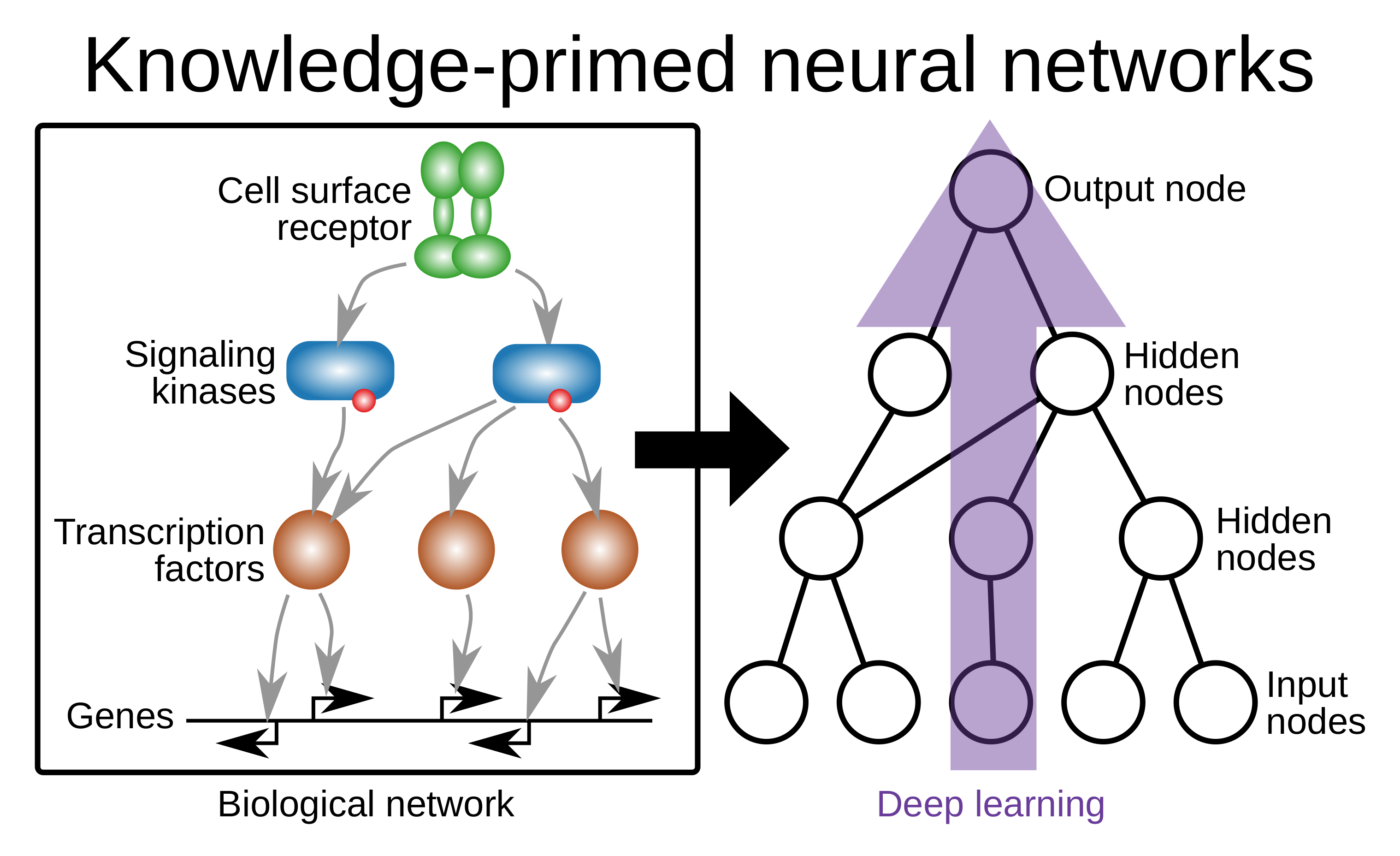
Figure 1. From a biological network (left) to a knowledge-primed neural network (right). Every node of the network is a named entity from the prior; the arrow marks the direction of information flow.
A knowledge-primed neural network (KPNN) achieves this by encoding prior knowledge as a graph. Every node of the network stands for a named entity, and an edge exists only where the prior records a relationship between two entities. Connections the prior does not contain are absent rather than merely small, so sparsity, which elsewhere in deep learning serves speed or memory, here carries the meaning of the model. Figure 1 shows the entity-based form introduced by Fortelny and Bock (2020). On the left, a cell-surface receptor signals through kinases to transcription factors, which regulate genes. On the right, the same wiring becomes a neural network that runs against the direction of signaling: gene expression enters at the input nodes, passes through transcription factors and kinases in the hidden layers, and reaches the receptor at the output node. Because each hidden node stands for a specific protein, an attribution score on that node says how much the trained model relies on that protein's unit, rather than on an anonymous one. Related models, also called visible or biologically informed neural networks, derive the graph from pathway databases or ontologies, such as P-NET, which is built on a hierarchy of Reactome pathways (Elmarakeby et al., 2021). Nothing in the construction is specific to biology: any domain whose entities have stable names and known relationships can be modeled the same way.
PyTorch can express such networks, but its standard components do
not. nn.Linear connects every unit of one layer to every unit of
the next (Figure 2a); a KPNN connects only the pairs its prior
names, and many of its edges skip layers (Figure 2b). The common
workaround multiplies each weight matrix by a fixed 0/1 mask.
Deriving those masks is a parsing problem in its own right: nodes
must be sorted into layers, edges that skip layers routed to the
correct inputs, and the column order of every layer fixed; all of
it must be redone whenever the prior changes. The more serious
difficulty is less visible. A KPNN reports its results by name, yet
inside the model a name is only an integer position, and nothing in
PyTorch checks that the two still agree. When they drift apart,
after a database update, with a feature table in a different column
order, or on reloading a checkpoint, the model still trains and the
loss looks normal, but the score reported for one gene belongs to
another. Such an error raises no exception and leaves no trace in
the metrics. Because published models have typically been
implemented with code written for one architecture, each new
project rebuilds this machinery and meets these pitfalls anew.
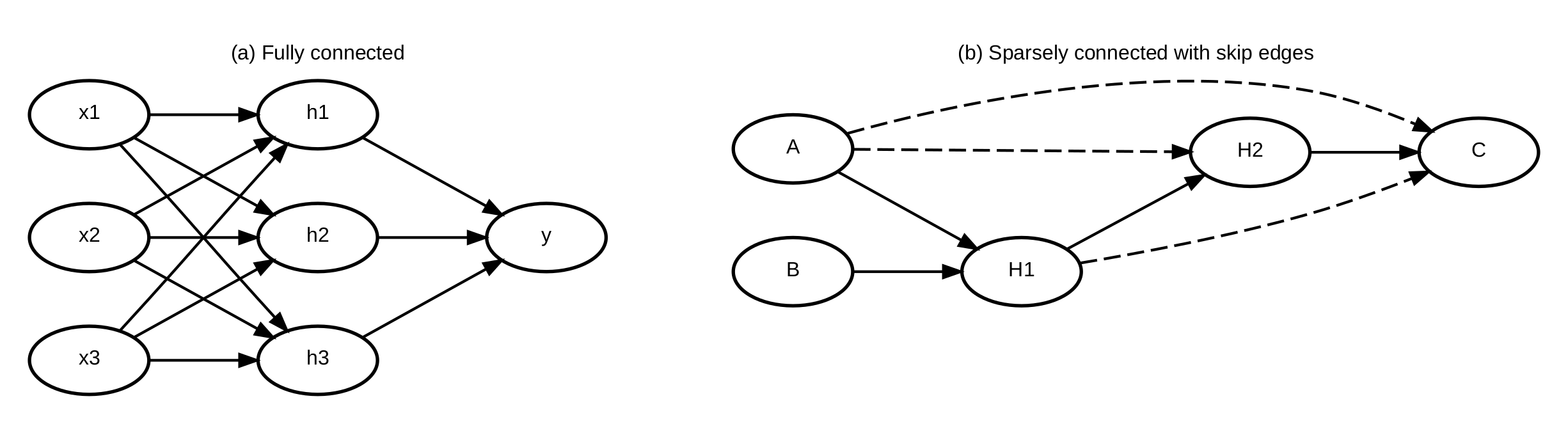
Figure 2. (a) Dense adjacent layers, the usual PyTorch case. (b) A sparsely connected network with skip edges (dashed), the same graph as on the Skip edges page.
kpnn2 resolves this by separating what the prior determines from
what the modeler decides. The prior determines which connections
exist and what each node is called, and kpnn2 handles exactly
that part. It derives the connectivity from a named edgelist once,
keeps every node name attached to its tensor position from parsing
to attribution, and checks that correspondence wherever names and
positions meet: when the prior is parsed, when input columns are
aligned, when a checkpoint is loaded, and when attribution scores
are labeled. Everything else, including activations, normalization,
dropout, output heads, losses, optimizers, the training loop, and
the choice of attribution method, stays in ordinary PyTorch code
that you write. The package provides building blocks, not a
finished model: there is no model compiler and no ready-made
network, so the model remains plain PyTorch that can be read,
changed, and extended like any other.
In practice, kpnn2 provides four kinds of building blocks:
- Parsers.
parse_layered()sorts an acyclic prior into layers and keeps each edge that skips layers in the layer it feeds.parse_adjacency()places all nodes in a single vector, which allows feedback loops and self-loops. - Sparse layers.
PackedLinear(one trainable weight per edge),MaskedLinear(a masked dense matrix for small graphs), andPackedMultiheadAttention(attention restricted to the prior's edges) take the place ofnn.Linearandnn.MultiheadAttention. - Name alignment.
align_inputs()orders feature columns by name, andmap_node_attributions()labels attribution tensors with node names. - Checks. Malformed priors, missing input columns, checkpoints
from a different prior, and attribution tensors of the wrong
width raise
Kpnn2Error; Checks where names meet tensor positions lists each check.
Core workflow
Concepts defines the terms these steps use.
- Define a model architecture as an edgelist with named
sourceandtargetnodes. - Parse it. For a
directed acyclic graph (DAG) you want
as layers, call
parse_layered(). It returns aLayeredSpecwith one packed hop per layer — a hop being everything entering one layer. For cycles, or for one shared state vector over all nodes, callparse_adjacency(). It returns anAdjacencySpecwhose edges are packed indices. A DAG is valid for both, so the layout is your choice. - Write an
nn.Modulewith onePackedLinearper hop inspec.hops, and feed each onegather_hop_inputs(saved, hop). Skip edges, whose endpoints are more than one layer apart, already sit inside those hops, so there is nothing extra to call.MaskedLinear(hop.to_mask())is the dense hatch for small graphs. - Align feature names with
align_inputs(), then index the host matrix. - Train with ordinary PyTorch.
- Optionally run Captum (or another method) yourself, then label a
layer tensor with
map_node_attributions()(returns xarray). - Optionally fold those scores with
aggregate_node_attributions(). - A checkpoint is
spec.to_dict()plusstate_dict, not weights alone.
Why not custom PyTorch?
A pathway prior is still a feedforward network, so you can
write one in plain PyTorch: sort the named nodes into layers,
build a mask for each hop, and pass W * mask to F.linear.
Written out, that preparation is a
parser — the code on the left
below is one. It also has to be rerun by hand: a single edge
added to the table can move nodes between layers, and the masks,
the layers each hop reads, and the column order of every
concatenated input all change with it.
kpnn2 replaces that preparation with one call to
parse_layered() and leaves the nn.Module as a loop over hops.
The edgelist stays the only description of the graph, skip edges
arrive already packed into the hops that read them, and
align_inputs() matches input names rather than positions.
Skip edges works through
the same point in a full example.
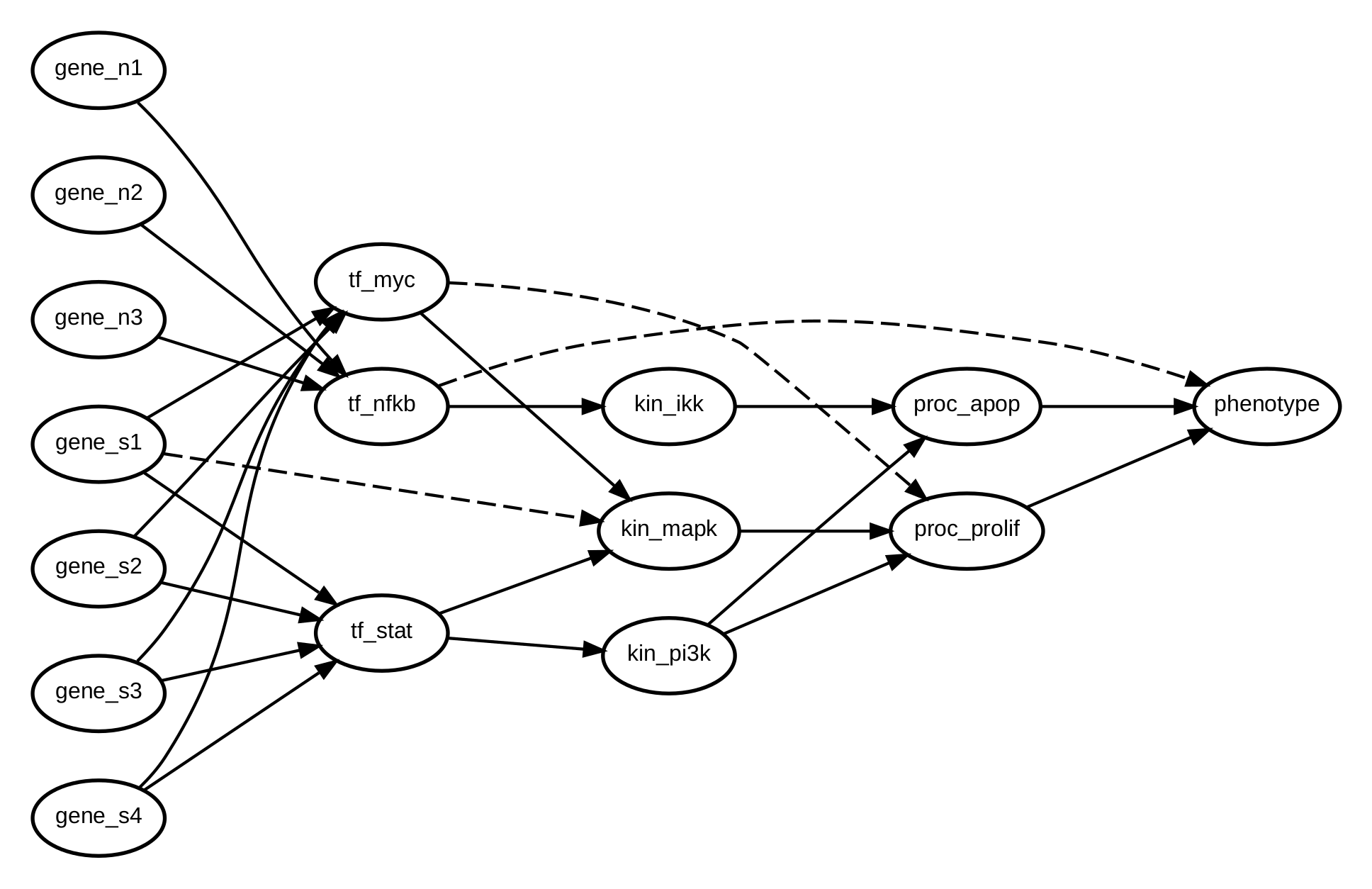
Figure 3. A sparse pathway prior: genes feeding transcription factors, kinases, cellular processes and a phenotype. Solid edges connect adjacent layers; dashed edges skip one. Both snippets below build this network from the same edgelist.
Custom PyTorch
from collections import defaultdict, deque
import pandas as pd
import torch
import torch.nn.functional as F
from torch import nn

edgelist = pd.read_csv("pathway_prior.csv")

missing = {"source", "target"} - set(
    edgelist.columns
)
if missing:
    raise ValueError(
        f"missing columns: {sorted(missing)}"
    )
pairs = edgelist[["source", "target"]]
if pairs.isna().any().any():
    raise ValueError("missing node names")
pairs = pairs.astype(str)
if (pairs == "").any().any():
    raise ValueError("empty node names")
loop_nodes = pairs["source"][
    pairs["source"] == pairs["target"]
]
if len(loop_nodes):
    raise ValueError(
        f"self-loops: {sorted(set(loop_nodes))}"
    )
if pairs.duplicated().any():
    raise ValueError("duplicate edges")

parents = defaultdict(set)
children = defaultdict(list)
nodes = set()
for source, target in zip(
    pairs["source"],
    pairs["target"],
):
    parents[target].add(source)
    children[source].append(target)
    nodes.add(source)
    nodes.add(target)

# Kahn's algorithm: recursion would overflow
# the stack on a deep graph and never return
# on a cyclic one. What it leaves unranked
# is the cycle.
in_degree = {
    name: len(parents[name]) for name in nodes
}
ready = deque(
    name
    for name in sorted(nodes)
    if in_degree[name] == 0
)
depths = {}
while ready:
    name = ready.popleft()
    if parents[name]:
        depths[name] = 1 + max(
            depths[parent]
            for parent in parents[name]
        )
    else:
        depths[name] = 0
    for child in children[name]:
        in_degree[child] -= 1
        if in_degree[child] == 0:
            ready.append(child)
if len(depths) < len(nodes):
    unranked = sorted(nodes - depths.keys())
    raise ValueError(f"cycle: {unranked}")

by_layer = defaultdict(list)
for name, depth in depths.items():
    by_layer[depth].append(name)
layers = [
    tuple(sorted(by_layer[depth]))
    for depth in range(max(by_layer) + 1)
]
masks = []
for depth in range(1, len(layers)):
    src_layers = []
    for src_depth, layer in enumerate(
        layers[:depth]
    ):
        if any(
            source in parents[target]
            for target in layers[depth]
            for source in layer
        ):
            src_layers.append(src_depth)
    col_of = {}
    col = 0
    for src_depth in src_layers:
        for name in layers[src_depth]:
            col_of[name] = col
            col += 1
    mask = torch.zeros(
        len(layers[depth]),
        col,
    )
    for row, target in enumerate(layers[depth]):
        for source in parents[target]:
            mask[row, col_of[source]] = 1.0
    masks.append((src_layers, mask))


class Net(nn.Module):
    def __init__(self, masks, n_inputs):
        super().__init__()
        self.n_inputs = n_inputs
        self.src_layers = [
            src for src, _ in masks
        ]
        self.lins = nn.ModuleList()
        self.masks = nn.ParameterList()
        for _, mask in masks:
            self.lins.append(
                nn.Linear(
                    mask.shape[1],
                    mask.shape[0],
                )
            )
            self.masks.append(
                nn.Parameter(
                    mask,
                    requires_grad=False,
                )
            )
        self.acts = nn.ModuleList(
            [
                nn.ReLU()
                for _ in self.lins
            ]
        )

    def forward(self, x):
        # Width is checkable, column order is
        # not: ordering x to match layers[0]
        # stays the caller's job.
        if x.shape[-1] != self.n_inputs:
            raise ValueError(
                f"expected {self.n_inputs} "
                f"columns, got {x.shape[-1]}"
            )
        saved = {0: x}
        h = x
        for i, (lin, mask) in enumerate(
            zip(self.lins, self.masks)
        ):
            parts = [
                saved[src]
                for src in self.src_layers[i]
            ]
            inp = (
                parts[0]
                if len(parts) == 1
                else torch.cat(parts, 1)
            )
            h = F.linear(
                inp,
                lin.weight * mask,
                lin.bias,
            )
            if i + 1 < len(self.lins):
                h = self.acts[i](h)
            saved[i + 1] = h
        return h


model = Net(masks, len(layers[0]))
kpnn2
import pandas as pd
from torch import nn

import kpnn2

edgelist = pd.read_csv("pathway_prior.csv")
spec = kpnn2.parse_layered(edgelist)


class Net(nn.Module):
    def __init__(self, spec: kpnn2.LayeredSpec):
        super().__init__()
        self.spec = spec
        self.lins = nn.ModuleList(
            [
                kpnn2.PackedLinear.from_hop(
                    hop,
                    identity=spec.fingerprint,
                )
                for hop in spec.hops
            ]
        )
        self.acts = nn.ModuleList(
            [
                nn.ReLU()
                for _ in spec.hops
            ]
        )

    def forward(self, x):
        saved = {0: x}
        h = x
        for i, (lin, hop) in enumerate(
            zip(self.lins, self.spec.hops)
        ):
            h = lin(kpnn2.gather_hop_inputs(saved, hop))
            if i + 1 < len(self.lins):
                h = self.acts[i](h)
            saved[i + 1] = h
        return h


model = Net(spec)
Both columns are correct. They build the same network, and both reject the same six malformed edgelists. The left one is several times longer, and it covers only the model: aligning input columns, saving checkpoints, and naming attributions still lie ahead, each with bookkeeping of its own.
Much of that length is not the model but the checks the masks depend on. A missing node name silently adds a node, a duplicated edge silently collapses into one weight, and a cycle has no layering at all, so the depth pass has to detect it rather than recurse forever. The left column holds every check its author thought of. The failure below is one they did not.
A checkpoint that loads the wrong wiring
Train the left model and save its state_dict. Months later, a
new database release revises one interaction in Figure 3:
gene_n3 now regulates tf_stat instead of tf_nfkb. No node
changes layer, so every tensor keeps its shape. Rerun the left
column on the new prior and reload the checkpoint:
# Before: trained on the old pathway_prior.csv
torch.save(model.state_dict(), "model.pt")

# After: the same script on the new pathway_prior.csv
model = Net(masks, len(layers[0]))
model.load_state_dict(torch.load("model.pt"))
# <All keys matched successfully>
The load succeeds, even with strict=True. The masks are
nn.Parameters, so they are saved in the state_dict, and the
old masks overwrite the new ones. The model runs the old wiring
while every name in the script comes from the new prior. Loss and
predictions look normal. Every attribution on gene_n3 flows
through gene_n3 → tf_nfkb, an edge the new prior says does not
exist.
The obvious fix moves the failure instead of removing it.
Register the masks as non-persistent buffers so they stay out of
the state_dict, and the load still succeeds. Now the new masks
gate weights trained under the old ones: gene_n3 → tf_stat runs
on a weight that never trained, and the trained
gene_n3 → tf_nfkb weight sits behind a zero.
With kpnn2, the same reload raises:
model = Net(spec)  # the new pathway_prior.csv
model.load_state_dict(torch.load("model.pt"))
Kpnn2Error: The checkpoint identity does not match this layer. The
mismatch is in submodule 'lins.0'. The checkpoint was saved with
identity '0f59017a8609...'; this layer has identity
'46a9dc2f04f2...'. Load a checkpoint saved from a layer built from
the same spec (with identity=spec.fingerprint). To move weights
onto a different prior, copy them by name with edge_location() on
the old and the new spec; see 'Changing the prior (reparse)' on the
PackedLinear page of the kpnn2 docs.
Each PackedLinear saves a digest of its packed indices and,
with identity=spec.fingerprint, the fingerprint of the named
prior. When either differs from the layer being loaded, loading
stops with Kpnn2Error.
Each failure like this one is fixable once you have seen it. The
hard part is seeing all of them in advance: this one needs a
prior update and a reload to appear, and neither column's code
hints at it. That is what kpnn2 is for. It owns the mapping
from node names to tensor positions (layers, packed edges, input
columns, checkpoints, attribution labels), so the checks on that
mapping are written and tested once, in one place, instead of
rediscovered by every project that writes its own.
Checks where names meet tensor positions
Each check sits where a name meets a tensor position, and each catches a mistake that would not show up in the loss.
- Malformed edgelists are rejected. Both parsers reject missing
columns, missing or empty names, and duplicate edges, which would
otherwise collapse into one weight. They also reject names that
differ only by leading or trailing whitespace, such as
"A"and" A"from a CSV with", "separators, which would otherwise split one node into two.parse_layered()also rejects cycles and self-loops. - Edges that skip layers stay in the wiring. Such an edge is
part of the layer it feeds, so that layer's input width includes
it, and
gather_hop_inputs()raises when an earlier layer it reads was never kept. - Input columns are matched by name.
align_inputs()finds each input node's column in your feature table. A reordered table, or one with extra columns, still lines up. A missing or duplicated name raises, and so does a column named like a node the model computes, whose values would never be read. - Checkpoints refuse a different prior. Each sparse layer saves
a digest of its wiring and, with
identity=spec.fingerprint, the fingerprint of the named prior. A mismatch raises instead of loading; A checkpoint that loads the wrong wiring shows what the hand-written version does. - Attribution scores are labeled from the parsed graph.
map_node_attributions()names every position of a layer tensor and raises when the tensor's width does not match that layer.
The checks stop at that boundary. Your forward(), your prior's
biology, and your attribution method stay yours to get right.
How we test lists what the tests pin and
what they do not prove.